Ummesalma Turkey•Owner••6 min read
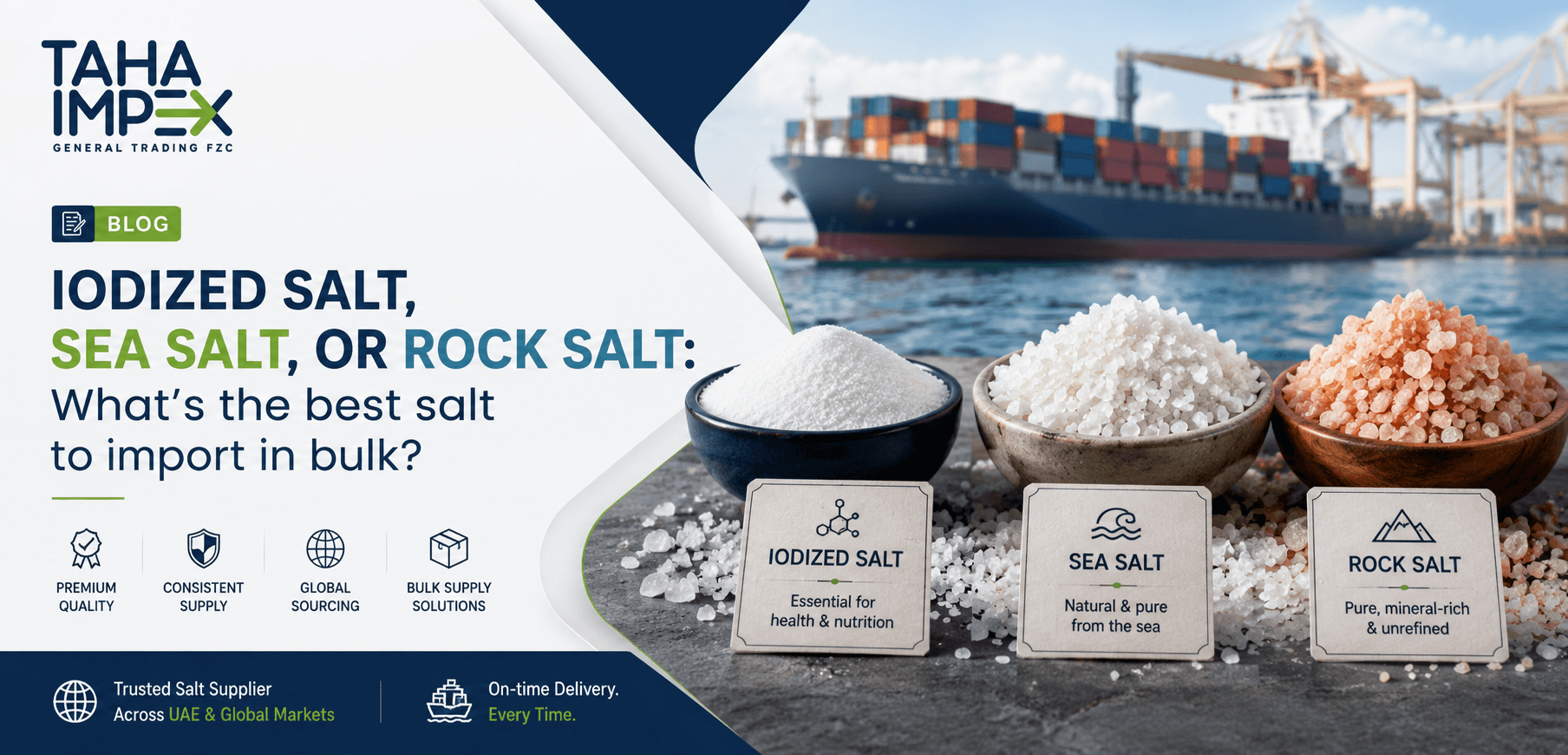
Iodized salt, sea salt, or rock salt: What's the best salt to import in bulk?
Iodine salt, industrial salt or gourmet salt : Salt guide for food manufacturer, a retail distributor, or an industrial buyer stocking up for winter de-icing season.
If you're sourcing salt in bulk for the first time, the sheer number of options can catch you off guard. Iodized, sea, rock—each type comes from a different production process, serves a different end market, and carries different compliance requirements. Choosing the wrong one doesn't just affect your margins; it can mean failed customs clearance, unhappy customers, or a product that doesn't meet local food-grade regulations.
This guide breaks down the three most commonly imported salt types so you can match your sourcing decision to your actual business need—whether you're a food manufacturer, a retail distributor, or an industrial buyer stocking up for winter de-icing season.
Quick Comparison
Type
Source
Purity (NaCl)
Common Uses
Shelf Life
Typical MOQ
Relative Price
Iodized Salt
Refined salt + added iodine compound
97–99%
Table salt, food fortification, retail packaging
2–5 years
1,000 kg+
Low–Medium
Sea Salt
Solar evaporation of seawater
85–98% (varies with mineral content)
Gourmet food, wellness products, some industrial use
5+ years (unlimited if kept dry)
500 kg+
Medium–High
Rock Salt
Mined from underground deposits
95–99%
De-icing, water softening, chemical processing, animal feed
Indefinite
5,000 kg+ (often sold in bulk MT)
What Is Iodized Salt?
Iodized salt is a refined salt — obtained by evaporating sea water, then processed to remove impurities -- by adding a small, carefully measured amount of potassium iodate or potassium iodide. The iodine addition isn't cosmetic; it's a public health measure. Iodine deficiency remains a global nutrition concern, and many governments require iodization in salt sold for human consumption.
Best use cases: table salt for retail, food manufacturing where a fortified product is required, and government or NGO nutrition programs.
Regulatory notes: Many countries mandate iodization for food-grade salt sold domestically and specify minimum iodine content per kilogram. If you're importing for the retail or food-service market, check the destination country's food safety authority requirements before finalizing your order — labeling rules typically require iodine content to be disclosed on packaging.
Who should import it: food and beverage brands, packaged goods distributors, government nutrition programs, and retailers serving the consumer table-salt market.
What Is Sea Salt?
Sea salt is produced by evaporating seawater, usually through solar evaporation ponds, leaving behind crystallized salt along with trace minerals like magnesium, calcium, and potassium. These trace minerals give different sea salts their characteristic color and flavor variations, and they're a major part of the marketing appeal in premium food and wellness segments.
Best use cases: gourmet and specialty food products, health and wellness brands, spa and cosmetic applications, and artisanal food manufacturing.
Import considerations: Sea salt can vary more in moisture content and granule consistency than refined salt, since it's less processed. If you're importing for food manufacturing (not just retail packaging), ask for salt specifications for moisture percentage and granule size. Remember that due to the smaller batch sizes and premium positioning, most sea salt commands will result in a slightly higher landed cost.
What Is Rock Salt?
Rock salt is extracted directly from underground salt deposits—the remains of ancient seas that evaporated and were buried over geological time. It's typically the least processed of the three, though grades range from crude mined chunks to refined rock salt suitable for food use.
Best use cases:
- Tablet Salt - Compressed salt tablets for water softening systems
- Pool Salt - Specialized salt for swimming pool chlorination systems
- De-Icing Salts - Effective road and walkway de-icing solutions
- Water Treatment Salt - High-purity salt for industrial water treatment
- Chemical Grade Salt - Ultra-pure salt for chemical manufacturing processes
Import considerations: Rock salt is typically the most cost-effective option to import in bulk and large volumes in terms of per-ton quantity, often by the metric ton rather than smaller retail-sized packaging. If you're an industrial buyer, demand can spike seasonally, as municipal and de-icing buyers in colder climates often place large orders ahead of winter, so lock in supply agreements early to avoid tight availability.
Choosing Based on Your Business Needs
- If you're a food manufacturer producing packaged goods for retail:
Iodized salt is usually the best choice, especially if your destination market has enhancement requirements. Refined sea salt is suitable for premium product lines, though verify moisture specs carefully.
- If you're a retailer targeting premium or health-conscious markets:
Despite having a higher raw cost per ton, sea salt typically commands higher shelf prices and stronger margins due to its mineral profile and "natural" positioning.
- If you're in industrial supply, municipal contracts, or chemical processing:
Rock salt is nearly always the best option because it is economical on a large scale and appropriate for non-food applications where flavor or mineral content are unimportant.
Not sure which grade fits your specific product line? Browse our salt product range or reach out for a sample before committing to a bulk order.
Key Factors to Evaluate Before You Import — Regardless of Type
Certifications:
Look for FSSAI (India), ISO 9001/22000, HACCP, and Halal or Kosher certification if relevant to your destination market.
Packaging and MOQ flexibility:
Confirm whether the supplier can accommodate your preferred bag size, container loading pattern, and minimum order quantity.
Incoterms:
Depending on whether you are buying FOB, CFR, or CIF, understand who is in charge of freight and insurance costs.
Supplier track record:
Request export history, current client references, and lab test reports from an independent third party.
Shelf life and storage:
Salt doesn't spoil on its own, but handling and caking are affected by moisture content. Make sure the supplier's packaging, particularly for sea salt, protects against humidity during transportation.
Final Thoughts
There isn't a single "best" salt to import; instead, it all depends on your target market. Depending on positioning, food manufacturers and retailers typically favor iodized or sea salt, but industrial and municipal buyers are nearly always better served by the cost-effectiveness of rock salt at scale.
Uncertain about the grade that best suits your market? Speak with the Taha Impex export team or request a sample; we'll assist you in matching the appropriate product, certification, and packaging to your particular buyer's needs.
Inquire with us for more details at enquiries@taha-impex.ae
Visit to explore variety of salts we export to more than 20 countries.
Ummesalma Turkey
Owner
Founder of Taha Impex